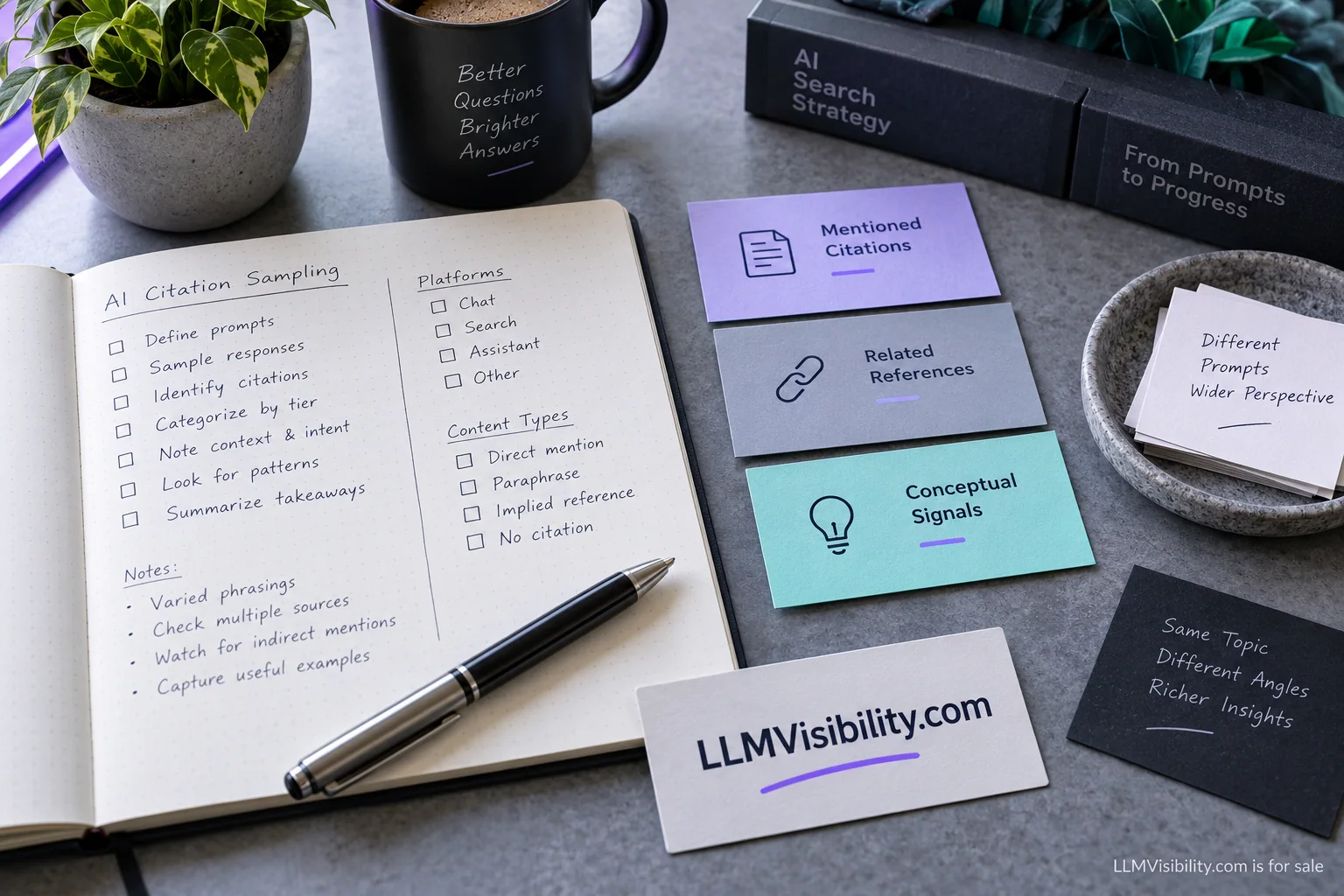
Write the measurement question first
A team asks whether its content is becoming more visible in AI answers. Before choosing a metric, it needs to decide what that question means. It might want to know whether a specific page receives citations, whether a brand appears in discovery answers, or whether outdated information is still being repeated. Each objective requires different observations and a different interpretation.
A useful measurement note begins with one sentence describing the decision the report will support. For example, a specialist publisher might want to identify which of its explainers appear as sources in a defined group of topic questions. That is a narrower and more testable aim than estimating the publisher’s presence across every possible conversation.
The sample should follow from that aim. Choose the questions, surfaces, markets, and collection period that are relevant to the decision. Record those choices before reviewing the results so that an attractive outcome does not quietly redefine the study.
Keep three levels of evidence separate
The first level is the raw observation. It contains the question, response, visible links, date, and collection conditions. A reviewer should be able to inspect the answer and confirm what was captured. This is the foundation for every later summary.
The second level is a sample summary. It might report the number of successfully collected answers containing a citation to the publisher’s domain. That number describes the collected sample under its stated rules. It becomes meaningful when the denominator and the treatment of missing observations are visible.
The third level is a business interpretation. A team might hypothesize that stronger source coverage could support discovery or improve understanding of its expertise. That interpretation needs additional evidence before it becomes a claim about customer behavior, revenue, or the effect of a particular editorial change.
Keeping these levels separate gives readers a way to assess the argument. They can agree with the observed count while questioning the broader interpretation. That is a productive disagreement because the evidence remains available for review.
Define the counting rules before collection
Decide what counts as a citation. A practical rule might require a visible source link attached to a returned answer. Specify whether the metric counts answers with at least one qualifying link, the total number of links, or distinct destination pages. These choices can produce very different numbers.
Consider an illustrative sample in which one answer links to three pages on the same domain. An answer-level measure counts one cited answer. A link-level measure counts three citations. A page-level measure counts three distinct pages if the destinations differ. None is inherently the right measure for every purpose; the report needs to state which question each one answers.
URL handling also needs a rule. Tracking parameters, redirects, and alternate page versions can split what a reviewer considers the same source. Keep the original link alongside any normalized destination so that the classification remains auditable.
Choose questions that represent the intended job
A question set is a research instrument. Its composition shapes the result. If every question mentions the target brand, the sample mainly examines answers about that brand. If the questions ask open comparisons, the sample examines a different kind of presence.
Organize questions by the buyer or reader job they represent. Mark the market, language, journey stage, and whether the brand is named. Keep a note on the evidence behind the wording. Customer language and published research can support a question, while an internally invented question should remain labeled as a hypothesis.
A stable tracking set can coexist with exploratory questions. Report them separately. The stable set supports comparison over time; the exploratory set helps the team discover new questions worth investigating. Moving an exploratory question into routine tracking should be a recorded decision.
Plan repetitions and preserve missing data
A repeated question can return different answers. The collection plan should therefore specify whether questions are observed once or several times, and how those observations are distributed across the review period. Repetitions should follow the plan instead of depending on whether the first result was favorable.
Missing observations need their own category. An access failure, incomplete response, or unavailable source view is different from a completed answer with no qualifying citation. If both are counted as absence, the report may confuse collection quality with answer presence.
State how missing data affects the denominator. A simple report can show planned observations, completed observations, and cited completed observations side by side. This makes the collection gaps visible without pretending that the unobserved answers are known.
Report a rate with its scope attached
One straightforward metric is the proportion of completed observations containing at least one qualifying citation to the target domain. Express it as a count as well as a percentage. A reader should see the scale of the evidence without having to reverse-engineer the chart.
For illustration, if 6 of 20 completed observations contain a qualifying citation, the sample rate is 30 percent. That describes those 20 observations. It does not establish that 30 percent of all users, all questions, or all answer surfaces will encounter the source.
Repetitions of the same question also share context, so they should not casually be treated as independent examples of the entire market. If formal uncertainty estimates are needed, the analysis should reflect how questions and repetitions were selected. A small operational report can simply show counts, variation by question, and the limits of the sample.
Make comparisons on comparable records
A trend requires a stable basis for comparison. Record changes to the question set, collection method, locale, surface, and review rules. If one period contains a new group of questions, show the result for the unchanged questions separately where possible.
Source changes deserve attention too. A destination might redirect, a publication might reorganize its archive, or a page might be replaced. A domain-level summary can conceal those changes. Retaining the original answer and link gives the analyst a way to investigate them.
Avoid declaring success from a single favorable period. Ask whether the change is concentrated in one question, whether collection coverage differed, and whether human reviewers agree on the classification. Those checks often reveal a more useful explanation than a broad headline about growth.
Connect observations to actions carefully
An editor updates a guide, and a later sample contains more citations to that guide. The timeline is worth recording. It does not by itself isolate the effect of the edit. Other source material, collection conditions, or answer behavior may have changed during the same period.
A good report can say that the increase followed the update and identify the evidence needed to investigate the relationship further. It can also evaluate the edit on its own merits: the information became current, the explanation became clearer, or the sourcing became easier to inspect.
Business outcomes require another layer of evidence. A visible citation, a referral visit, and a qualified inquiry are distinct events. Connect them only where the available records support the connection, and leave unknown parts of the journey visible.
Draft a one-page measurement note
Use five short sections: purpose, sample, collection, counting rules, and interpretation. Name the owner of the question set and the person responsible for reviewing ambiguous citations. Include a place to record changes between periods.
Finish with the decision the first report should enable. It might identify pages for editorial review or establish a baseline for future observation. The GEO monitor concept shows how this evidence could fit into a product, while the brand answer suite considers the review work that follows. A clear note makes either direction easier to evaluate because the meaning of the measurements is already written down.