Start with the work, then choose the label
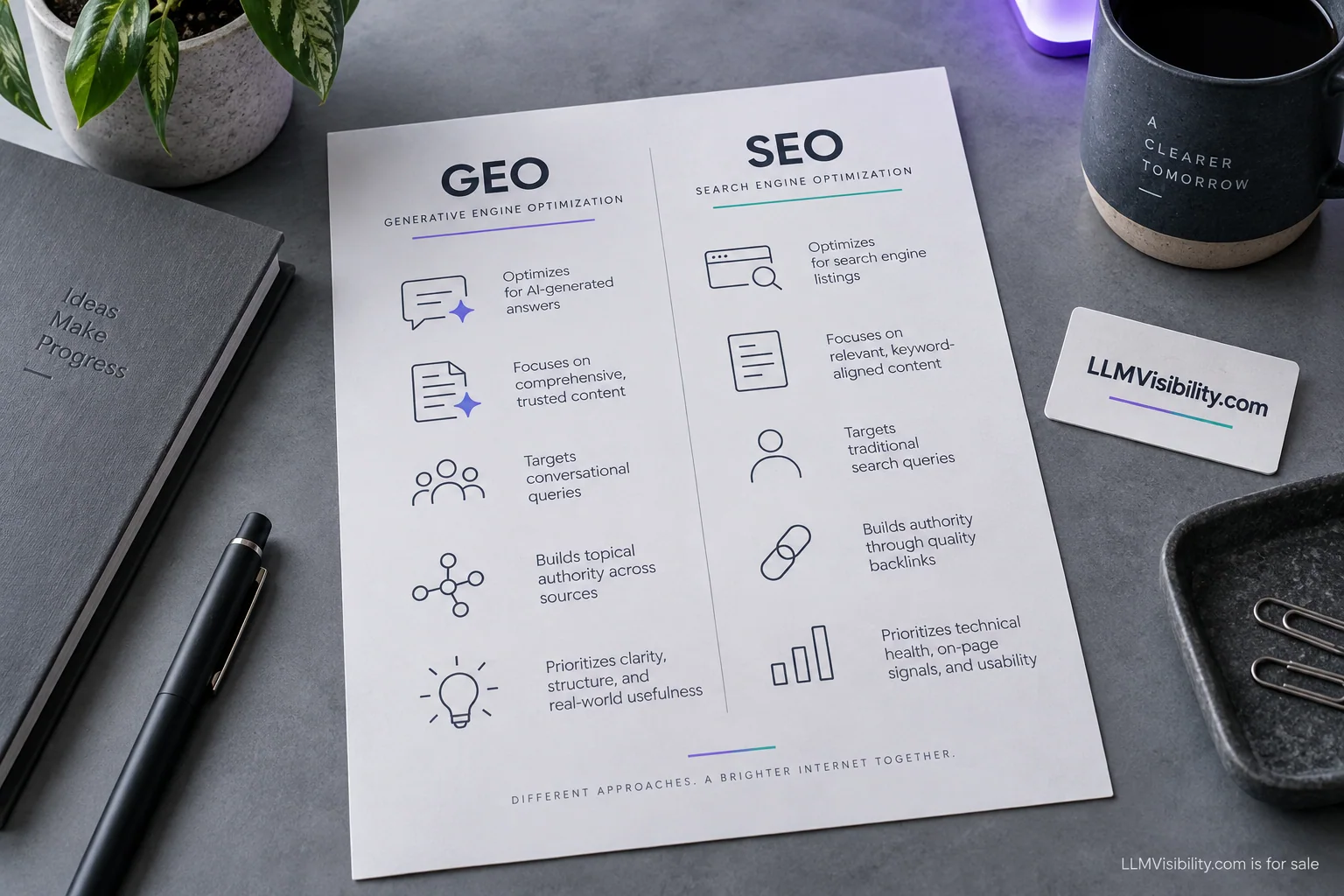
SEO commonly describes work intended to help people discover useful pages through search engines. GEO, or generative engine optimization, is often used for work concerned with how information appears in generated answers. The terms overlap because the same public pages, facts, and explanations can serve both kinds of discovery.
For a working team, the useful question is how to assign tasks and evaluate them. A technical specialist may need to fix an access problem. An editor may need to explain a product more clearly. An analyst may need to collect and review answers to a defined set of customer questions. Calling all three tasks GEO does not make their methods or success criteria identical.
A clear work plan names the task, the person responsible, and the evidence that completion will produce. The category label can help organize the plan, but the plan should remain understandable without relying on the label to explain everything.
The shared foundation is useful, accessible information
A page cannot serve a reader well if its central explanation is hard to find or its facts are out of date. Search work and answer-focused work both give teams reasons to inspect those basics. Clear headings, informative titles, accurate descriptions, and links to supporting material help make the page easier to assess.
Google explicitly says that established SEO practices remain relevant to its AI features and that there are no additional technical requirements for those features beyond its stated Search eligibility conditions. Its guidance also says that no special AI markup is required. That is a platform-specific statement, not a universal account of every answer system. See Google’s documentation on AI features and websites.
The practical implication is to inspect existing work before creating a separate program. If the organization already maintains sound documentation and useful topic pages, answer-focused research can build on that base. A new label should not cause a team to lose track of ordinary content responsibilities.
Access work has a concrete technical owner
Access questions include whether the intended page can be reached, whether important information is present in the delivered page, and whether the site’s own instructions match the publisher’s intentions. These questions belong with the people responsible for the website and its infrastructure.
An answer-presence analyst might identify a page worth inspecting, but a missing citation does not by itself prove an access failure. The technical team should investigate using the appropriate evidence for the system and page in question. A report should distinguish an observed absence from a verified technical problem.
This division prevents speculative repairs. If a team changes several access settings simply because a brand was absent from one answer, it may create new problems without resolving the original question. A defined technical issue gives the work a testable completion condition.
Editorial work begins with the reader’s need
An editor can ask whether a page answers a useful question, whether its claims have support, and whether its scope is clear. A comparison page should explain the criteria used. A product page should make capabilities and limitations understandable. A research article should preserve the context needed to interpret its findings.
Those tasks have value for people who arrive through many routes. The editor can judge a revision by whether it improves the explanation and factual accuracy. Citation monitoring may help identify which page deserves attention, but it should not replace the publication’s standards.
For example, an answer might refer to a product as suitable for a market it does not serve. The editorial task could be to clarify the supported markets in the product documentation. The team can verify the published correction. Whether a later answer reflects that correction remains a separate observation.
Answer observation adds its own research work
A GEO program often introduces a question set and a recurring collection of generated answers. That work requires decisions about buyer jobs, markets, surfaces, repetitions, and review rules. It also requires a way to retain evidence so that a summary can be checked later.
Questions that name the brand should be labeled separately from questions that do not. Product comparisons should be distinguished from definitions and support questions. These categories help the analyst explain what kind of presence the sample measures.
The person managing the sample should keep a change log. Adding new questions or changing the collection method can affect the results. If the team presents a trend without explaining those changes, readers may attribute the difference to the market when the measurement itself has changed.
Put the responsibilities side by side
| Workstream | A concrete task | Evidence of completion |
|---|---|---|
| Technical access | Investigate a documented page-access issue | A recorded check showing the intended page is accessible under the tested conditions |
| Editorial quality | Clarify a product’s supported use cases | Approved, published copy with the relevant facts and sources |
| Answer observation | Review a fixed set of buyer questions | Saved answers, source links, collection notes, and classifications |
| Reporting | Explain changes within a defined sample | A report with denominators, gaps, and comparable periods |
| Business evaluation | Review qualified inquiries from a known route | Records connecting the observed visit or referral to the inquiry |
The table is an illustrative way to organize responsibilities. A small team may assign several rows to one person. A larger organization may distribute them across departments. In either case, the output should be clear enough that another person can tell whether the task was completed.
Use different measures for different questions
Search traffic can tell a team about recorded visits from search. A citation review can tell it about links visible in collected answers. A content maintenance log can tell it which pages were updated. None of these alone describes the full customer journey.
A report becomes more useful when each measure has a stated purpose. If the purpose is factual accuracy, track reviewed inaccuracies and their resolution. If the purpose is discovery research, describe the question set and observed answer patterns. If the purpose is customer acquisition, examine the available journey evidence and acknowledge the parts that cannot be connected.
Teams can place these measures beside one another without merging them into a single score. That makes it easier to see a real tradeoff, such as spending editorial time on a correction that matters to customers even when its effect on observed citations is unknown.
Keep experimentation small enough to interpret
Choose a limited change and write down the reason for making it. Record the page, the date, the intended audience, and the expected improvement for the reader. If answer observations are part of the evaluation, keep the relevant question set and collection conditions as stable as practical.
A later difference is a reason to investigate, not automatic proof of the change’s effect. Several factors may have changed during the same period. A useful experiment note states what the team observed and which explanations remain plausible.
This approach supports learning even when the result is inconclusive. The team still has a better page, a record of the decision, and a clearer understanding of what its measurement can resolve.
Choose one task for this week
Find a customer question that the existing website answers poorly. Ask an editor and a subject expert to review the relevant page. Agree on one concrete improvement, publish it through the normal approval process, and record the change.
If the team also collects AI answers, save a small set of observations with the exact questions and dates. Keep the content improvement and the observed answers as distinct parts of the record. The definition of LLM visibility can help establish consistent labels, while the publisher toolkit concept explores how these editorial responsibilities could become a focused product.